The Lesson from PISA 2025 U.S. Math Results: We invested in what students are taught, but we still haven't fixed how.
New field observations from Modern Classrooms Project identify five instructional shifts that decide whether an adopted math curriculum impacts every student.
Yesterday the OECD published results from PISA 2025, its assessment of 15-year-olds across 91 countries and economies in fields including science, reading, mathematics and computational problem solving. While much of the attention globally is on the significant decline in reading across many countries, the story on U.S. mathematics performance is more mixed: U.S. student performance in math declined less in terms of PISA points than the OECD average (-11 OECD vs -2 U.S. vs 2022), however while some headlines this week may highlight the U.S. moving up in the global math rankings, it’s only because other countries declined more.
U.S. math performance has been sliding since 2018. That year, U.S. 15-year-olds averaged 478 in mathematics, well below the OECD average of 496. By 2022 the U.S. had fallen 13 points to 465. In 2025 it stands at 463, the lowest the U.S. has recorded in PISA. Over the same three years the OECD average fell 11 points, which is why the U.S. rose in the rankings while essentially showing no progress in learning. What’s more challenging, the share of American 15-year-olds who cannot reach basic proficiency in math continued to climb, from 33.9% in 2022 to 35.2% in 2025.
Education leaders across the country have not ignored these results. Over the past decade, thousands of school, district, and state leaders made one of the hardest and most expensive instructional decisions available to a school district: they replaced their math curriculum.
As of 2024, 47% of districts had adopted math HQIM for grades K-5, and 42% for grades 6-8. This represents a massive investment of time and resources: Districts vetted materials against efficacy evidence and state standards, funded the adoption, trained teachers on it, and rebuilt scope and sequence around it.
Our perspective: Adoption and implementation are different problems
This investment is critically important and warranted. High-quality instructional materials are necessary to close math proficiency gaps. However they do not close them alone, because how the materials get delivered decides what students actually receive. At the Modern Classrooms Project we refer to this as the implementation layer.
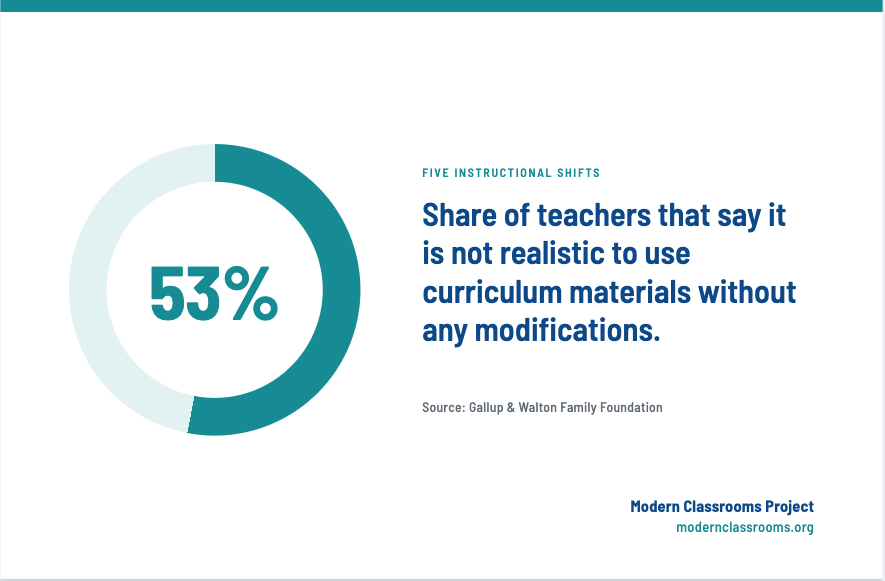
The national data on this is consistent. RAND's 2025 American Instructional Resources Survey found that most teachers who adopt new instructional materials report substantially modifying them in practice. A 2026 survey from Gallup and the Walton Family Foundation suggests why, with more than half of teachers saying that using curriculum materials without modification is unrealistic, and only 38% reporting having clear expectations for how curriculum may be adapted.
The temptation among education leaders and policymakers may be to read that gap as a compliance problem, best addressed with more monitoring. We read it differently.
High-quality math curricula are written based on a set of assumptions about the classroom they will enter. They assume a teacher can respond to individual students inside core instruction. They assume students arrive at each unit holding the prerequisites the next one requires. They assume assessment data will be acted on while it still matters, and that students will engage with demanding tasks as active participants.
When the daily structure of a classroom cannot support those assumptions, teachers adapt the curriculum so the period works for as many students as possible, while still staying on pace. That is not a failure in terms of curriculum fidelity, rather it’s a rigid design meeting the realities of today’s classrooms, with teachers bridging the gap.
The five instructional shifts
Our new white paper, Five Instructional Shifts That Drive Successful Math HQIM Implementation, identifies five structural shifts that let a strong curriculum work as designed :
From time-based progression to mastery-driven instruction
From invisible progress to visible progress tracking
From one-size-fits-all to flexible small-group instruction
From passive reception to empowered learners
From generalized support to precise 1:1 feedback
Each shift has its own independent research foundation. What the white paper contributes is treating them as an interconnected set, showing how they reinforce and build on one another, and defining each one concretely enough that an educator can directly observe it in their classrooms. A commitment to mastery is what the other four shifts support. Visible tracking gives teachers the evidence to act on it, and flexible small-group instruction gives them the time. Student ownership and precise feedback both become possible only once those are in place.
What we found through field observations
We studied these shifts inside our Math Mentorship Program during the 2025-2026 school year, working with 30 K–12 district partners implementing some of the most commonly used math curricula. We collected 171 teacher surveys and 424 classroom observations in spring 2026, tracking the same teachers before and after the program.
Across those surveys, teacher-reported practice shifted in every category:
Teachers reporting meaningful opportunity to work 1:1 or in small groups: 29% to 79%
Teachers who know how to efficiently assess students based on mastery: 65% to 93%
Teachers able to help students who missed class catch up: 29% to 75%
Teachers with a clear routine for giving feedback: 74% to 91%
84% of teachersnow report the curriculum works better than it did on its own
“I now see how clear routines, progress tracking, and opportunities for student ownership can help meet the needs of a wider range of learners and create a more engaging math classroom.”
PISA measures where students end up, not necessarily what transpired in the classroom to get them there. Today’s report is a reminder that for all the investments we’ve made towards improving math proficiency in the U.S. we still have a long way to go. Addressing that requires taking a candid look not just at what students are being taught, but how they are being taught within the realities of a modern classroom.
Read the full white paper
The Five Shifts white paper is one view into just that, blending established research with real world observations from classrooms all over the country. It highlights what has to change inside daily instruction so that curriculum adoption becomes genuinely effective curriculum implementation.
*OECD notes incomplete responses from U.S. schools may have influenced the results, so a word of caution is advised.
