

Research-Backed Instructional Shifts
Five Instructional Shifts That Drive Successful Math HQIM Implementation
This 2-page Research Brief outlines the 5 shifts, the findings, and the research base. No form required. To download the full 30+ page white paper, see below.
K–12 district leaders have made the hard part of the math instruction decision. They selected a high-quality curriculum, funded it, trained on it, and rebuilt a scope and sequence around it. Many are now finding that adoption and successful implementation are different problems.
Drawing on 30 K–12 district partners, 171 teacher surveys, and 424 classroom observations, this research identifies the five shifts in instructional practice that determine whether a strong curriculum reaches every student.

High-Quality Instructional Materials assume conditions most classrooms are not built to support.
These five shifts build them.
Uncover what each shift looks like in practice, the research base behind it, and what the Math Mentorship Program data shows about implementation in real districts by reading the full 30+ page research report.
The national data is consistent. RAND's 2025 American Instructional Resources Survey found that while nearly half of K-12 teachers adopt new instructional materials each year, most report using a single curriculum while substantially modifying it in practice. A 2026 Gallup and Walton Family Foundation survey suggests why: more than half of teachers say using curriculum materials without modification is unrealistic, and only 38% report having clear expectations for how curriculum may be adapted.
Your curriculum is written on a set of assumptions: that teachers can respond to individual students inside core instruction, that students arrive at each unit with the understanding the next one requires, and that assessment data gets acted on while it still matters. Those assumptions are reasonable. They are also structural, and no set of materials can install them on its own.
Our educator-led, mastery-based approach, grounded in the science of learning, is what makes those assumptions true in a real classroom. Teachers check what every student has learned, then use that evidence to decide who needs what next.

The Missing Layer: The 5 Instructional Shifts
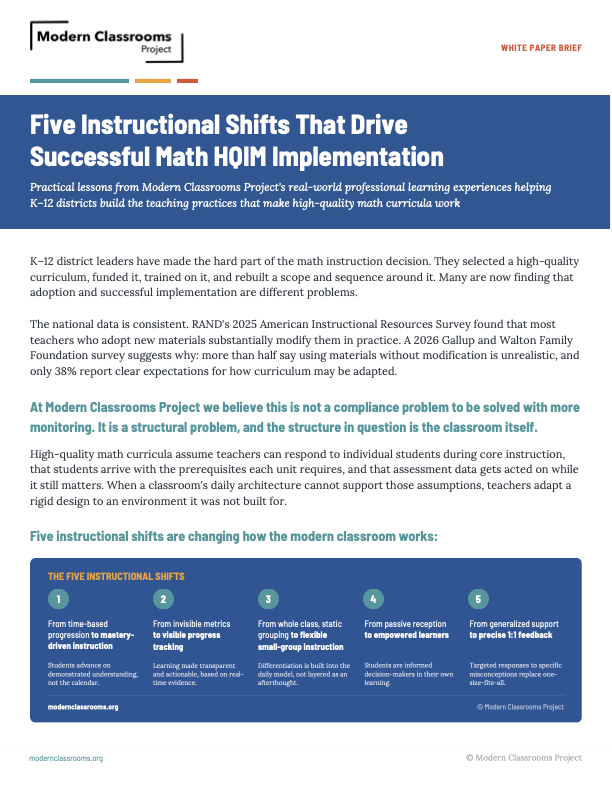
This research lays out these five specific shifts via observable, repeatable, and most importantly, coachable patterns that are shown to support student learning. They are interconnected and build on one another. A commitment to mastery is what the other four shifts support. Visible tracking gives teachers the evidence to act on it, and flexible small-group instruction gives them the time. Student ownership and precise feedback both become possible only once those are in place.

From time-based progression to mastery-driven instruction

From invisible metrics to visible progress tracking

From one-size-fits-all to flexible small-group instruction

From passive reception to empowered learners

From generalized support to precise 1:1 feedback

Measuring Impact in a Modern Math Classroom
Across the 2025 to 2026 Math Mentorship Program, we worked with 30 K-12 district partners implementing some of the most widely used math curricula. Across 171 surveys and 424 classroom observations, we tracked teacher self-reported responses to working with their HQIM before and after completing the MMP the program.
171
teacher survey responses, spring 2026
30
district partners
424
classroom observations, spring 2026
