
From One-Size-Fits-All to Responsive Instruction: Leading Differentiation at Scale
Mayflower teachers are moving toward responsive education in the hopes of truly meeting the needs of every learner while maintaining rigor.
In many Arkansas classrooms, teachers are expected to meet students at wildly different readiness levels—the percentage of students both below Basic and at Advanced for grade 4 mathematics in the last five years continues to be the largest these groups have been in the last 20 years (or more), according to NAEP. Arkansas students’ math performance over the last five years has reached its lowest point since 2003—and yet, educators are expected to continue keeping the class moving through the curriculum. The result is predictable: some students are bored, some are lost, and some are absent altogether. As a result, teachers will inevitably feel forced to reduce rigor and teach to the middle. In Mayflower Public Schools, 4th-grade math teacher Allison Wilbanks reported “students looking bored or not really understanding.” And while her experience is not unique, do we have to accept this as a simple reality of teaching?
This isn’t one teacher’s classroom management issue or one school’s training problem—it’s a system-wide problem that affects learners’ ability to learn. We can’t expect educators to meet every learner’s needs through a one-size-fits-all approach. Though differentiation has inherent value in supporting the needs of every learner, it is rarely implemented at scale in ways that support educators in meaningfully moving the needle on mastery.
For district leaders, the question is no longer whether differentiation matters, but how to support it effectively.
Differentiation Defined
Differentiated instruction is best understood not as a set of isolated strategies, but as a deliberate approach to teaching that responds to meaningful differences among learners. Researchers define differentiation as the intentional tailoring of instruction through modifications to content, process, product, and the learning environment in order to better support individual learners (Wilkinson & Penney, 2014; Smale-Jacobse et al., 2019). Differentiated instruction requires educators to adjust curriculum, pedagogy, and delivery methods so that all students can access rigorous learning experiences (Roy et al., 2013; Tomlinson, 2014, 2015; Mbugua & Muthomi, 2014).

In practice, this requires:
Access to high-quality instructional materials, including curriculum and other resources
Implementation of a variety of instructional strategies that support all students to achieve mastery
Classroom systems that support students on their individual learning journeys toward the course’s shared learning goals.
Importantly, differentiation is not about writing 25 separate lesson plans or lowering expectations for some students; it is about designing classrooms that are responsive. Tomlinson et al. (2003) emphasize that differentiation is rooted in deep respect for learners and requires teachers to proactively modify instructional resources, activities, and expectations to ensure all students can thrive. Smale-Jacobse et al. (2019) further explain that effective differentiation includes both pedagogical decisions (what teachers differentiate and how) and organizational structures (such as grouping practices and pacing systems), highlighting that differentiation is not synonymous with rigid ability tracking but instead relies on flexible, purpose-driven instructional design (Corno, 2008; McQuarrie et al., 2008; Valiande & Koutselini, 2009).
Differentiation matters in mathematics because math learning is uniquely cumulative—when students miss key concepts early, gaps compound quickly and can shape not only achievement but also confidence and persistence. Research suggests that differentiated instruction, particularly when it intentionally adjusts content, process, and product, can significantly improve student mathematical achievement by varying levels of structure, support, and autonomy in learning tasks (Rijal, Aswarliansyah, & Waluyo, 2025). Even short-term differentiated instruction has been shown to improve performance and increase students’ confidence in solving foundational problems, making it especially valuable for students who have historically struggled in mathematics (Aguhayon, Tingson, & Pentang, 2023). Yet despite its promise, differentiation is notoriously difficult to implement in math classrooms because traditional pacing often forces teachers to choose between supporting students who need more time and challenging students who are ready to move forward. In this sense, differentiation is not simply a pedagogical preference—it is a response to the reality of student variability, particularly in mathematics. Mayflower students themselves highlight the emotional stakes: one shared that before self-paced learning, they “didn’t really feel confident in math,” but with more flexible pacing, they no longer felt “rushed or like I have somebody waiting on me.” Differentiation in math is hard because it requires more than good intentions; it requires structures that allow teachers to respond to real-time learning needs and provide immediate feedback to correct misunderstandings.
Differentiation Done Differently
This year, Mayflower Public Schools has taken a different approach to supporting differentiation at scale. Instead of discussing differentiation as an individual teacher strategy, it is embedded as a system-level instructional model. Mayflower’s District Math Specialist, Veronica Hebard, has been heavily involved in supporting educators in shifting their pedagogical approach to meet the needs of every student, and the team has been thoughtful about when and how they are rolling out the training and support. Through implementation of the Modern Classrooms approach, teachers maintain their high-quality instructional materials while redesigning how time, pacing, and feedback operate within the classroom. Rather than replacing content or dumbing it down, the model strengthens the curriculum by creating the conditions that support turnkey differentiation: formative assessment, flexible learning paths, and responsive instructional decision-making (Smale-Jacobse et al., 2019; Tomlinson, 2014).
As an example, in Mayflower, math class could look like this:
Begin with a whole-class warm-up, designed to activate prior knowledge and build student discourse.
Teachers facilitate an inquiry task, allowing students to explore concepts collaboratively before formal instruction.
From there, the classroom shifts into a structured self-paced learning block, supported by checklists, guided notes, practice tasks, and instructional videos that students can revisit as many times as they need to. This self-paced time is not unstructured independent work; it is the engine that creates time for targeted support.
Students complete short mastery checks aligned to the lesson objective. These short one- or two-problem quizzes allow educators to quickly assess student understanding
Teachers use formative data to pull small groups and provide individual feedback.
Class concludes with a closure routine that reinforces learning and gives students a chance to reflect on misconceptions and growth.
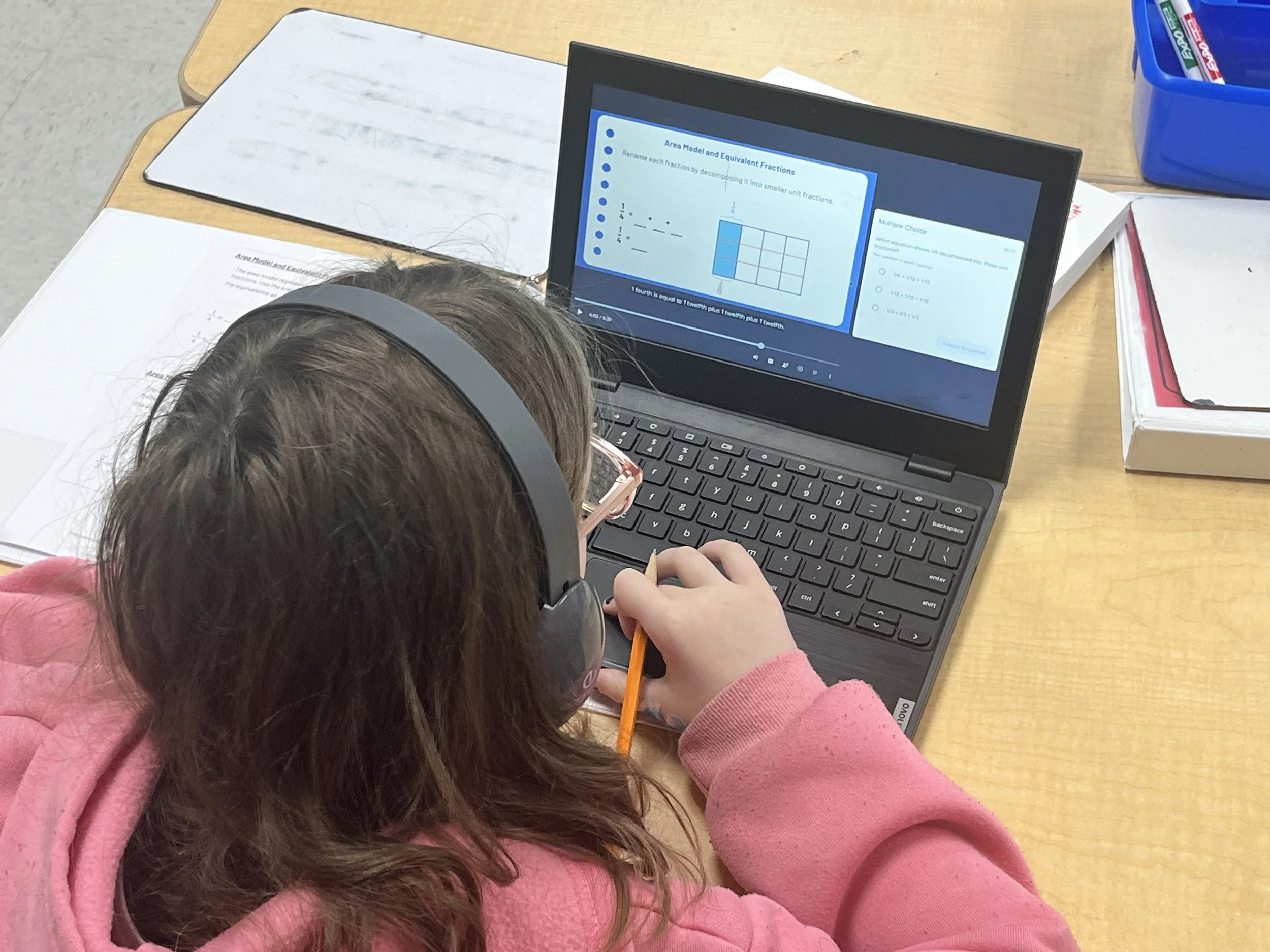
Where in the past, educators may have had capacity restraints and pacing guides that required them to leave kids who missed a lesson or who needed extra 1:1 support behind, they now have more freedom to provide targeted support when and where they need. Orienting classrooms toward mastery also allows educators to use the data to guide their differentiation. Mastery checks function as real-time formative assessments, allowing teachers to identify misconceptions quickly and trigger a reassessment loop when students need additional support. This structure reflects what research consistently emphasizes: differentiated instruction is inseparable from continuous assessment and flexible adaptation, and it succeeds best when embedded in an intentional organizational system rather than left to teacher improvisation (Smale-Jacobse et al., 2019; Deunk et al., 2018).
But scaling differentiation from one classroom to an entire district takes intentional leadership decisions.
3 Ways District Leaders Can Enable Differentiation with Veronica Hebard
1. Protect and define instructional time structures
Before leaders can scale differentiation, they have to answer a basic question: What does differentiation actually look like in a classroom? Too often, districts roll out the language of differentiation without defining the instructional structures that make it possible. In Mayflower, Veronica is still refining how to help building leaders develop a shared vision for student-centered math instruction—but that work is essential. If principals and instructional leaders cannot clearly picture the end goal, they cannot coach toward it, protect time for it, or evaluate it fairly.
Teachers also cannot be expected to take instructional risks without this clarity. Imagine being observed during a self-paced math block by a leader who has only ever seen whole-group instruction. Without shared understanding, principals may mistake strong student-centered routines for a lack of control, or confuse mastery-based pacing with a sink-or-swim approach. Both misunderstandings are damaging: the first discourages innovation, and the second risks undermining rigor and accountability.
When leaders understand the structure of differentiated classrooms—how warm-ups, self-paced learning, mastery checks, and small-group instruction work together—they can provide meaningful feedback, reinforce high expectations, and protect the time teachers need to differentiate effectively. Building leaders who know what to look for can identify whether students are engaged in productive learning, whether pacing is purposeful, and whether teachers are using data to respond to student needs. Most importantly, educators gain confidence that the support they receive is aligned to research-backed instruction rather than personal preference. From that foundation, differentiation becomes scalable—not because teachers work harder, but because the system is designed to support it.
2. Make pacing flexible without losing rigor
Have we really lost the forest for the trees when it comes to pacing student learning? By treating pacing guides as rigid requirements rather than suggested timelines, we create predictable outcomes: students who are behind fall further behind, students who are ready for challenge disengage, and teachers feel forced to cover content instead of ensuring mastery. A curriculum needs to be used with integrity, both to provide rigorous, aligned learning that is flexible enough to support all students.
In Mayflower, leaders are building a system where students are held accountable for mastery through clear learning targets and aligned assessments, but they are not punished for needing additional time or support. Fourth-grade educator Allison articulated this culture shift: “Students know it’s okay if I am a little bit behind my neighbor because we’ll end up catching back up together.” This is the heart of flexible pacing—students are not released from expectations; they are given a structured pathway to meet them.
For district leaders, the work is not simply giving teachers permission to slow down. It is building systems that allow pacing flexibility without instructional drift: protecting time for reteaching, ensuring that teachers have clear standards-aligned mastery expectations, and creating common language around what it means to be on track. When pacing becomes responsive instead of rigid, differentiation stops being an extra task and becomes the natural result of a well-designed instructional system.
3. Foster a deep understanding of formative assessment
Formative assessment provides the backbone that makes this all work. It acts as the data engine to respond to students in real time rather than relying on unit tests or end-of-quarter results. But too often, educators and leaders misunderstand formative assessment as something formal, infrequent, or compliance-driven—another spreadsheet, another benchmark, another meeting. In reality, formative assessment is not always a test; it is a continuous process of gathering evidence of learning and using that evidence to adjust instruction immediately (Smale-Jacobse et al., 2019; Tomlinson, 2014). Without this cycle, differentiation becomes guesswork.
In Mayflower, mastery checks provide a clear example of formative assessment functioning as it should: short, standards-aligned measures that give teachers immediate information about student understanding. These checks are not “gotcha” quizzes or grading tools—they are instructional signals. Educators can use this data to pull small groups for reteaching, a practice that aligns directly with research emphasizing that high-quality differentiated instruction depends on frequent assessment and flexible instructional adaptation (Smale-Jacobse et al., 2019). When students struggle, the response is not to move on anyway; it is to reteach, reassess, and ensure understanding before advancing.
District leaders can strengthen differentiation by ensuring formative assessment is embedded into instructional expectations and professional learning. This includes training teachers to interpret formative data quickly, creating schedules that allow small-group reteaching during the school day, and helping principals identify whether formative assessment is being used as a tool for learning rather than a tool for grading. When leaders prioritize formative assessment as a classroom practice—not an accountability event—teachers gain the ability to intervene earlier, students gain faster feedback, and differentiation becomes sustainable at scale.
The national data from educators who implement the Modern Classrooms model suggests that when differentiation is built into instructional design, it becomes both more effective and more sustainable. Initially, only 51% of educators who attended a Modern Classrooms Project summer training reported agreeing with the statement “I am able to effectively serve students at all levels of understanding.” Three months after the training, 78% of educators agreed, and nine months later, this number increased to 84%. Instead of becoming yet another demand on teachers’ plates, educators are finding that this approach makes their jobs easier. Where only 49% of trainees initially agreed that teaching felt like a sustainable career, compare that to 78% at three months and 89% at nine months. And unlike many of the fleeting “district initiatives,” it appears this has a lasting impact on educators’ instruction. Before training, only 24% of educators agreed that they had plenty of opportunities to work 1:1 or in small groups with students; three months after training, that figure rose to 73% and remained high at 70% nine months later. These results reinforce what Mayflower’s educators describe firsthand: when differentiation becomes a system, teachers regain the time and structure needed to ensure all students can succeed.
For Arkansas instructional leaders, the lesson from Mayflower is both practical and hopeful: differentiation does not require abandoning rigor, rewriting curriculum, or asking teachers to do the impossible. It requires leadership decisions that protect time, prioritize formative assessment, and normalize flexible pacing as part of high-quality instruction. When districts build structures that make small-group instruction routine, mastery data actionable, and student progress visible, differentiation shifts from aspiration to reality. As Mayflower’s experience shows, when the system changes, classrooms change—and when classrooms change, students who once felt rushed, overlooked, or left behind begin to experience mathematics as something they can access and master. The task before district leaders is clear: design systems where differentiation is implemented well at scale. After all, the question is not whether students are different. The question is whether our system is designed to respond.