
Students and Screen Time
The question isn’t how much screen time.
It’s what kind.
Educators and parents are right to be cautious about student screen time. The concerns driving today's policy conversations and public debate are real and well-documented, and the research on recreational screen use is serious. But blanket restrictions on use of technology in classrooms risks pulling out the kinds of screen use the evidence consistently supports: structured, curriculum-aligned, teacher-designed instructional video and supportive tools that extend what teachers do rather than replacing it.
At Modern Classrooms Project, that distinction is the whole point. Everything we do, from our instructional model to the tools and content we create, is designed around thoughtful, research-backed use of technology that frees teachers to spend more time with students in small group and 1:1 interactions, not less.
For a deeper understanding of the existing research, please download the free Student Screen Time: A Modern Classrooms Project Research Brief.

Not all screen time is the same
The research makes a distinction that often gets lost in public conversation: not all screen time has the same effects. The strongest evidence of harm centers on unstructured, recreational, displacing uses, such as social media scrolling, personal smartphones during class, and bedtime device use that crowds out sleep, face-to-face interaction, and sustained attention.
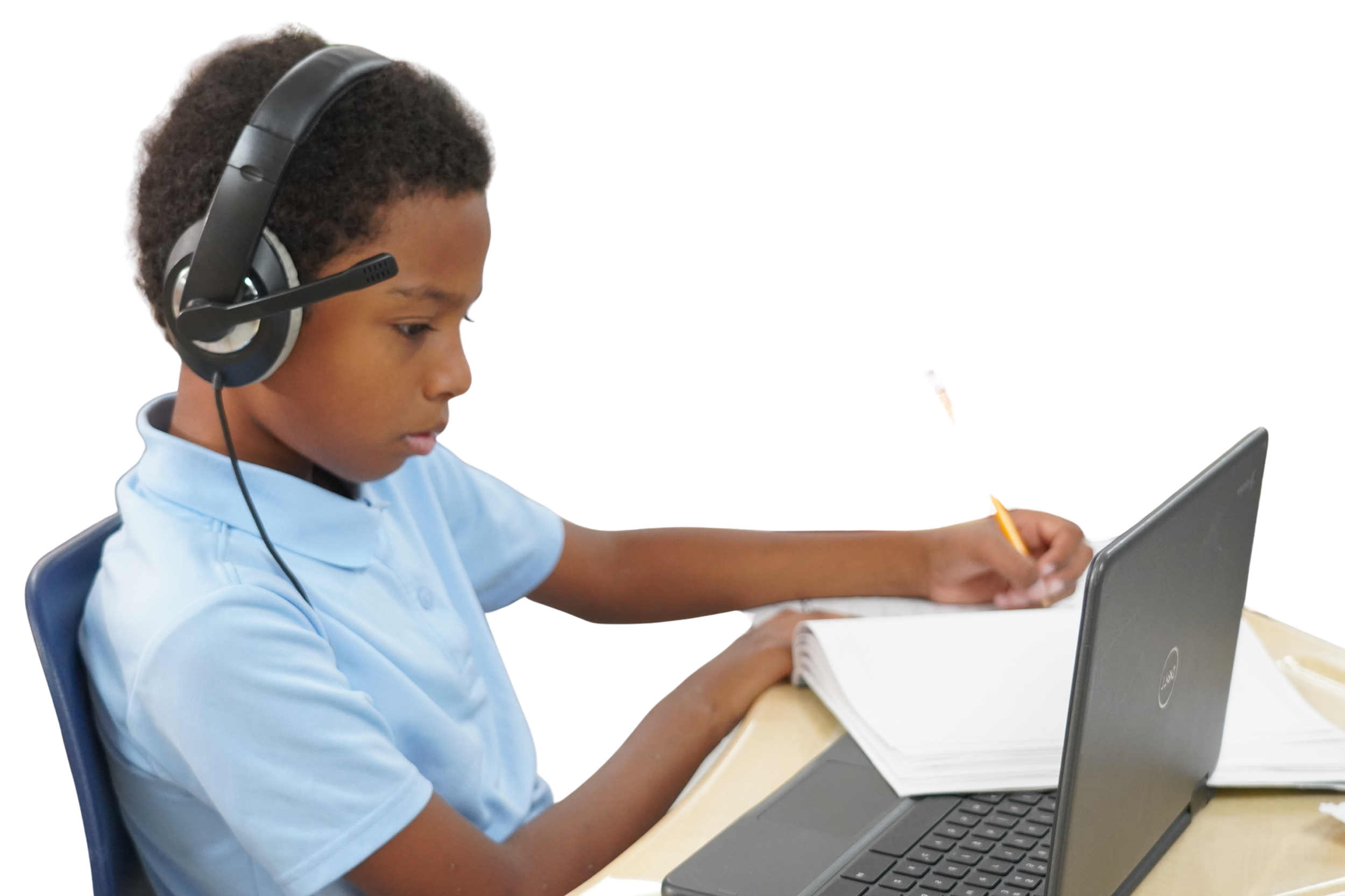
A teacher-designed instructional video, used inside a planned lesson, is a different thing entirely. Studies that separate types of screen use consistently find that educational, learning-focused screen time is associated with neutral or positive outcomes relative to recreational use. Even the research most often cited to raise alarms identifies educational programming and adult co-viewing as positive predictors of children's language development.
In the Modern Classrooms model, instructional video is a purposeful, curriculum-aligned learning tool. It supplements and enhances teacher interaction with students, it never replaces it. This is the same design philosophy that drives every tool we create for teachers.

“Over the years implementing MCP and switching my instruction to videos, I get way more time to sit with kids one-on-one or in small groups. This made a big difference when I had a high student-to-teacher ratio, where whole-group instruction just didn’t work for everyone. Now in a special education setting, it’s just as impactful. I can reteach, scaffold, or adjust on the spot based on what each student needs.”
What the research says
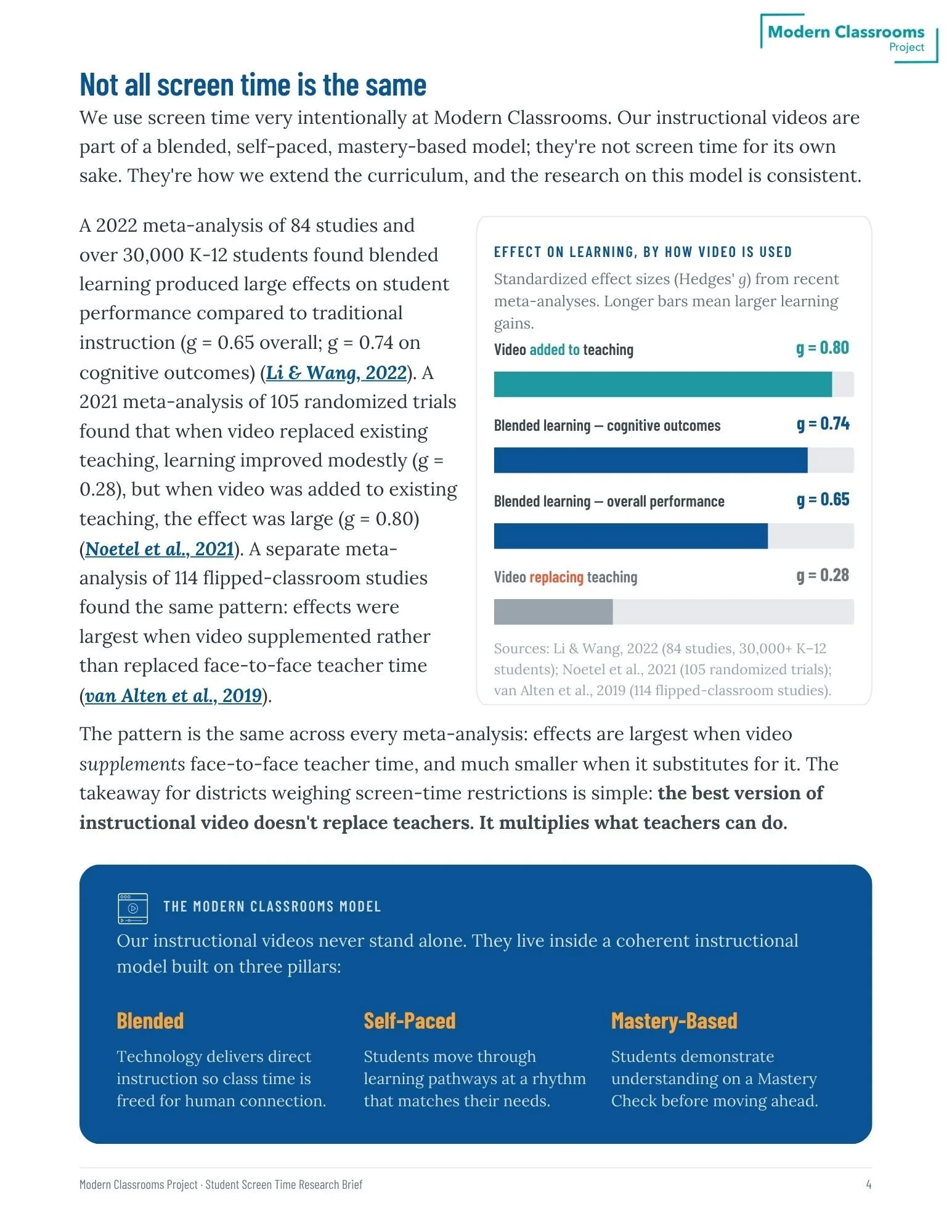
We use screen time intentionally. Instructional videos created within the Modern Classrooms approach are part of a blended, self-paced, mastery-based model, and the evidence is consistent.
A 2022 meta-analysis of 84 studies and more than 30,000 K–12 students found blended learning produced large effects on student performance compared to traditional instruction (g = 0.65 overall; g = 0.74 on cognitive outcomes).
A 2021 meta-analysis of 105 randomized trials found that when video replaced existing teaching, learning improved modestly (g = 0.28). When video was added to existing teaching, the effect was large (g = 0.80).
A separate meta-analysis of 114 flipped-classroom studies found the same pattern: effects were largest when video supplemented rather than replaced face-to-face teacher time.
The takeaway for any school or district leader weighing screen-time policy: the best version of instructional video doesn't replace teachers. It amplifies what teachers can do.
More teacher time, not less
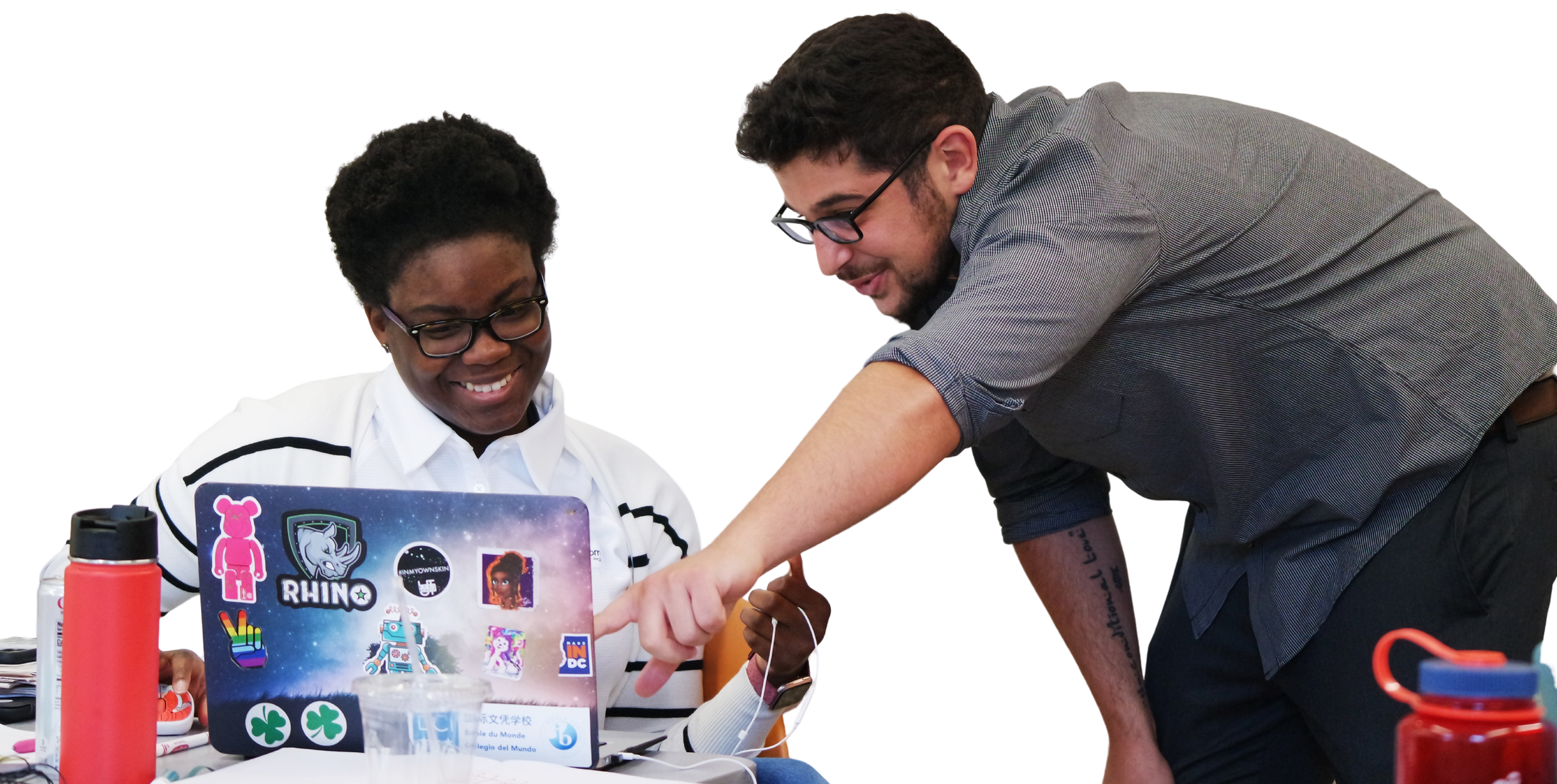
This is the part that gets missed. When direct instruction lives in a short video, class time stops being dominated by one-to-many lecturing and shifts to more one-on-one and small-group support. Students get their teacher's instruction on demand and can re-watch when they're stuck. Teachers spend their class time where they matter most: working with students.
Students in this model report more frequent communication with their teacher than students in traditional formats, and they perceive measurable social presence when their teacher appears on video. That is the version of instructional video Modern Classrooms Project is built around.
“I would recommend this training because it allows teachers to have time to implement small-group instruction and more one-on-one time with students, instead of standing at the front of the room lecturing for 60 minutes and struggling to find time to intervene.”
How effective instructional video is actually designed
MCP's approach to instructional videos is designed around the principles that decades of cognitive science point to. Three threads run through that research.

Well-designed video matches how learning works.
People learn more deeply from words and pictures together than from words alone. Effective video honors three constraints of human cognition: separate auditory and visual channels, limited working memory, and the need for active processing. Built this way, video reduces extraneous load and frees working memory for the real work of constructing understanding. For novice learners, most students in grades 3 to 12 meeting new material, that matters. Video is also an ideal way to deliver worked examples, one of the most-replicated findings in instructional research, because students can pause, rewind, and re-watch each step on their own terms.
Good instructional video doesn't look like a recorded lecture.
The largest study of video engagement to date found the most engaging videos are short, under six minutes, informal, and segmented. Even high-quality lecture recordings underperformed. MCP's videos are short, targeted, segmented, and interactive. Embedded questions reduce mind-wandering and improve learning over passive viewing, and they work as retrieval practice that prompts students to review or re-watch.
Instructional video doesn't replace teacher interaction.
It relocates direct instruction so class time can shift to support. Students get instruction on demand, re-watch when stuck, and report more contact with their teacher, not less.
“The structure has…freed me up to spend more class time in small‑group and one‑on‑one conferences, rather than delivering whole‑group lectures. I’ve been able to target support to students who need more scaffolding while allowing others to move ahead, which has improved relationships and made my feedback more immediate and meaningful.”
Four questions to ask of any tool in your classrooms — including ours
We believe the right question isn't whether students should ever see a screen. It's whether the screen use in your classrooms is structured, curricular, and earning its place. Ask any tool to answer these four. Here's how we answer.
Does this tool add to instruction, or just take up time?
Videos creating using the MCP instructional model deliver curriculum-aligned direct instruction, which frees teachers to spend class time with students rather than at the front of the room. In Spring 2026, 89% of teachers said MCP resources made delivering their curriculum easier. 79% (~80%) of teachers surveyed in Spring 2026 agreed with the statement "I had plenty of opportunities to work 1:1 or in small groups with my students."
Does the tool improve student engagement and ownership?
78% of teachers report that students take more ownership of their learning when using the MCP model, and 71% report that students learn more, as measured on formative and summative assessments.
Is the tool backed by evidence?
A 2026 analysis of 150 of the most commonly used K–12 ed-tech tools found purpose-built educational tools had ESSA-aligned evidence in 40% of cases, versus just 2% of consumer technologies used in schools. Much of the ed tech in classrooms today has no evidence base at all. Our model is grounded in the research above, and two external studies evaluating its impact are currently underway.
Does the tool risk the kind of screen use the harm research is actually about?
The strongest evidence of harm points to passive scrolling, recreational social media, personal smartphone use, and bedtime device use. None of that describes a short, structured, teacher-designed video viewed inside a teacher-led classroom. Ours is the opposite of the screen use the research warns about.
The key takeaway educational leaders
The concerns are real, and the policy instinct to protect students from harmful screen use is sound. But the evidence draws a line, and the most effective school and district policies should draw it too: between recreational, displacing screen use and structured, curricular, teacher-designed instruction.
At Modern Classrooms Project, we believe that technology and screen time, thoughtfully and intentionally applied, fosters human connection, authentic learning, and social-emotional growth. It should never replace teaching or teachers, but enhance both, and it should always be grounded in the science of learning.
A complete bibliography covering all referenced sources on this page or in the downloadable research brief.