
Methods of Measuring Mastery
Modern Classrooms Project educators have developed many different means of effectively assessing student work.
Note that these rubrics are generally more applicable to regular mastery checks than they are to more formal end-of-unit assessments. For those assessments, we recommend that separate rubrics be created and used.
Example #1: Grace’s Writing Checklist
*** Teacher’s explanation: During an English Unit, students are often asked to write full paragraphs based on work they have done in class. These paragraphs ultimately serve as draft pieces of each unit’s final essay. This rubric is used to assess a student’s draft paragraphs; a student must reach the 80% line to move on to the next lesson, but is encouraged to reach the 100% line to produce a draft that is as strong as possible .***
Mastery Checklist for Writing Tasks
Correct capital letters, periods, conjunctions, and commas
Topic sentence
Evidence
Analysis/paraphrase
--------80% Line--------------------------
Transition Words
Vocab Words
Style
--------100% Line------------------------
Example #2: Rob’s Math Rubrics
*** Teacher’s explanation: When a student completes a math lesson, I give them 1-2 problems as a mastery check. I print the rubric below at the bottom of each mastery check, and ask students to self-assess before giving their work to me. I then review and score the student’s work - during a brief conversation with the student where possible. If the work scores 3 or above on all three dimensions, the student can advance or reassess (to get a 4); if not, the student must revise and reassess (to get a 3 or 4). I then enter the score of 3 or 4 into my gradebook.***
Student-Facing Directions: Once you have completed your work for any lesson, and before presenting your work to a teacher, complete the self-evaluation below. Don’t forget explanations. Remember that if you have any score of 3 or less, you will need to revise your work! Once ready, review your work and this rubric with a teacher. Your teacher will discuss your work and give you a final score accordingly.
Mastery Check Rubric
4 (A)
3 (B)
2 (C)
1 (D)
Understanding of Content
Application of Knowledge
Quality of Communication
I understand ALL of this lesson’s content.
I applied ALL of what I learned.
I expressed ALL of my work clearly.
I understand MOST of this lesson’s content.
I applied MOST of what I learned.
I expressed MOST of my work clearly.
I understand SOME of this lesson’s content.
I applied SOME of what I learned.
I expressed SOME of my work clearly.
I understand LITTLE of this lesson’s content.
I applied LITTLE of what I learned.
I expressed LITTLE of my work clearly.
Example #3: Narrative Writing Rubric
*** Teacher’s explanation: This teacher uses a four-point rubric to assess mastery checks and communicate next steps with her students. The next steps at the bottom of the rubric support clear procedures for all learners.***
4
Students meet all of level 3 and are able to accurately descrive how to use 3 or mnore narrative elements in their example vignette.
3
Students are able to identify a clear and specific moment to write about.
Students are able to accurately describe how to use 2 narrative elements in their example vignette.
2
Students are able to identify a clear and specific moment to write about.
1
Students attempt to complete the mastery check, but they are unable to complete it without help.
Move on to next lesson and plan to complete any Aspire To Do components.
Move on to the next lesson.
Redo the lesson.
Re-teach with the teacher.
Example #4: IB Writing Rubric
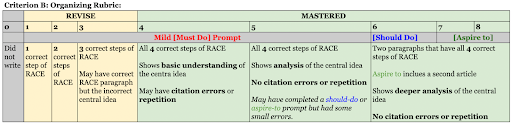
*** Teacher’s explanation: This example is from a teacher in an International Baccalaureate school, thus the 0-8 scale. You’ll notice that this teacher worked in Must Do, Should Do, and Aspire to Do into their rubric. This allows students to see what work they will need to do in each classification. ***
Example #5: Elementary Math Rubric
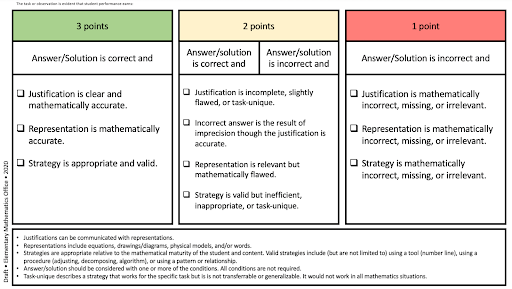
*** Teacher’s explanation: This rubric is one that could be used across many lessons/units in math which will help students to be familiar with expectations and have a set routine. Students who receive a 3 go on to the next assignment, students who receive a 2 meet with the teacher to quickly clarify any misconceptions, and students that receive a score of a 1 redo the lesson and then retake the mastery check.***
Example #6: Elementary Phonics Rubric
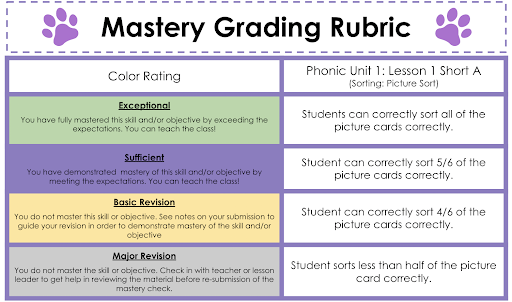
*** Teacher’s explanation: This example is from a Kindergarten teacher and is used within a sequence of lessons that covers teaching letter sounds. This teacher will be using the colors to help share feedback with students but also has a written explanation that is helpful for caregivers and other stakeholders. On the right, the teacher explicitly states the expectations for how many problems the student will need to get correct to show they have mastered the content.***
How are you measuring mastery? We invite you to explore more resources related to mastery, including:
Read 📖 Education Week: “Building a Culture of Revision, Reassessment and Reflection in Pursuit of Mastery”
Listen 🎧 the Modern Classrooms Project Podcast episode 189: “Mastery-Based Teaching and Learning”
Listen 🎧 the Modern Classrooms Project Podcast episode 254: “Mastery-Based Learning Insights”
Read 📖 NGLC: “A Leveled Approach to Mastery-Based Grading”
Read 📖 Cult of Pedagogy: “How to Set Up Mastery-Based Grading in Your Classroom”
Discover the research: “Promoting Positive Learning Experiences in Middle School: The Middle School Modern Classroom: Why a Blended, Self-Paced, Mastery-Based Grading Classroom is Ideal for Middle School Students”